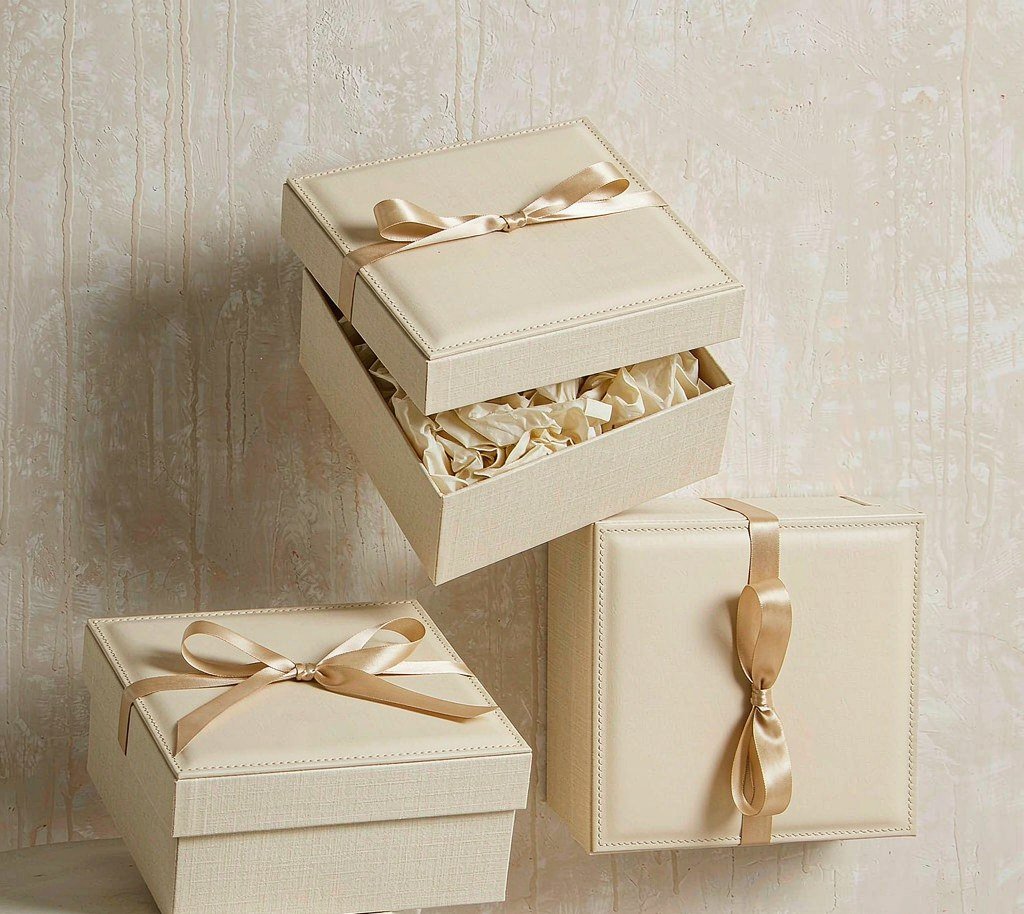
Gift packaging carries an unusual burden: it has to work twice. Once as protection for whatever is inside, and once as a social object — something the buyer hands over in front of other people, and something the recipient photographs. That double duty explains why gift boxes are specified so differently from ordinary retail cartons, and why the cheapest quote is rarely the one that ends up on the shelf.
This article covers the structures, materials, insert options and cost mechanics behind custom gift boxes, with the timing and compliance details that decide whether a gift programme actually lands in stores on time.
Rigid or Folding: The First Decision
Every gift box conversation starts here.
A folding carton is printed paperboard that ships flat and is erected at the packing stage. It is cost-efficient, freight-friendly and prints beautifully. For gift sets sold at accessible price points and for high volumes, it is usually the right answer.
A rigid box is built around greyboard and wrapped in paper. It cannot be flattened, it holds its shape under stacking, and it delivers the weight and resistance that consumers read as quality. For any gift programme positioned as premium, rigid is the default.
The trade-off is freight. A rigid box travels at roughly three to five times the volume of the equivalent flat-packed carton. Always compare landed cost, not ex-works cost, before declaring folding the cheaper option — particularly on sea freight into Europe or North America, where cube efficiency decides your total spend.
Six Configurations That Cover Most Gift Programmes
Two-piece (lid and base) box
The classic. A lid that sits over a base with a visible shoulder gap. Simple, elegant, and inexpensive to tool. Works for almost any product that sits in an insert.
Magnetic closure box
A rigid box with concealed magnets in an overlapping flap. It opens with a soft, deliberate resistance and closes with a satisfying snap. The most requested structure for premium gifting because the open-and-close motion is intrinsically satisfying.
Drawer box
Outer sleeve, sliding inner tray, often with a ribbon pull. It creates a two-stage reveal, which suits multi-item gift sets where you want the contents discovered rather than displayed immediately.
Book-style box
Hinged like a hardback book, opening flat. Best for wide, flat formats and for sets where the interior layout is part of the presentation.
Shoulder-neck box
A tight inner neck inside a wider shoulder, creating a distinct shadow line. A strong architectural statement for minimalist brands.
Corrugated mailer box
The e-commerce workhorse. Printed corrugated board that folds into a self-locking box, ships flat and survives parcel networks. If your gift is sold online, this is often both the shipping carton and the presentation box in one, which removes an entire layer from your packing line.
Getting the Insert Right
An insert is not a filler. It is what stops a product from moving, and what tells the customer the product is finished before they touch it.
- EVA foam — precision cavities, a jewel-box feel, and the ability to hold irregular shapes. The premium default.
- Moulded pulp — fibre-based, curbside recyclable in many markets, and increasingly specified by brands under pressure to remove plastic.
- Paper-board fitments and corrugated platforms — the economical middle ground, and surprisingly effective when the product has a regular shape.
- Fabric-wrapped trays — satin or velvet-covered trays for jewellery, cosmetics and small leather goods. High impact, higher cost.
Two rules apply regardless of material. First, design the cavity from the actual product, not the product’s nominal dimensions — a 1 mm tolerance on a moulded component becomes a rattling box. Second, test a packed box by shaking it beside your ear. If you hear movement, the insert is not finished.
Sizing: Where Money Is Won and Lost
Gift boxes are routinely oversized by 5–10 mm on every face because teams design around a visual impression rather than a measurement. Multiplied across four faces and a pallet, that habit costs real money and weakens the presentation, because a product that rattles inside a too-large cavity feels cheaper, not more generous.
Work from the packed product dimensions, add the minimum wall clearance your insert requires, then add board thickness on each side. On a 100,000-unit programme, a 5 mm reduction across the footprint often pays for the upgrade from a folding carton to a rigid box.
Materials and Finishes Worth Knowing
Board selection sets the floor on perceived quality. Greyboard at 1.5 mm feels quite different from 2.5 mm, even with identical artwork and identical wrapping paper. Wrapping stock does the rest: coated art paper for crisp four-colour print, uncoated and textured papers for a dry, natural touch, and soft-touch lamination for the velvet finish that beauty and fragrance brands favour.
On finishing, restraint reads as confidence. Hot foil stamping delivers a genuine metallic mark that catches light across a room. Embossing and debossing add dimension without colour, which photographs beautifully on social. Spot UV adds a gloss pattern against matte. Ribbon closures, satin pulls and edge painting are the details that separate a good gift box from a memorable one — and they are also where your per-unit cost escalates fastest.
The Gift Season Timeline
Gift packaging is the most seasonal category in the industry, and the most penalising when it is late. A rough planning sequence for a Q4 retail programme:
- Design and structure approval — leave time for at least one physical round of revisions.
- Sampling — a pre-production sample in the final material and finish, not a digital mock-up.
- Production — account for finishing passes, which run sequentially, and for quality inspection.
- Freight — sea freight takes weeks; air freight costs multiples. Port congestion in peak season is a schedule risk, not an exception.
- Buffer — build in contingencies. Gift programmes that ship in December are decided in spring.
One additional factor: production capacity in China slows around Chinese New Year. If your gift launch sits in the first quarter, confirm your factory’s calendar before you promise a delivery date to a retailer.
Sustainability, Costed Honestly
The most sustainable gift box is the one that is the right size, made from FSC-certified or recycled board, finished with water-based adhesives, and free of plastic film. Paper-over-board constructions with pulp inserts are widely recyclable in European kerbside streams, whereas laminated boards and foam inserts frequently are not.
Be careful with language. Terms such as “eco-friendly” or “plastic-free” have specific regulatory meanings in several markets, and packaging claims are increasingly policed. If you want to make a recyclability claim, make sure the whole pack — box, insert, ribbon, adhesive — supports it, and document the materials.
A Buyer’s Checklist for Gift Packaging
- Landed cost per unit at your actual order quantity, including freight and duties.
- One signed colour reference sample, kept by both parties.
- Insert tolerance test with the real product, not a 3D print.
- Drop test from parcel-handling height in e-commerce configuration.
- Closure cycle test for magnetic and drawer formats.
- Certificate of chain of custody for fibre-based materials, if you intend to claim it.
The Three Specification Mistakes We See Most Often
First, designing the box around a digital mock-up rather than a physical sample. Fluting, wrapping paper texture and lamination all change how a finish reads, and none of them can be judged on screen. Second, under-budgeting the insert to protect the box cost — an insert is a small share of the total and the single largest influence on how the product feels when the lid comes off. Third, specifying a size before the contents are finalised, which forces a second die and a second approval cycle.
A fourth, subtler mistake is treating the gift box as a one-off. Brands that build a structural system — one box format in three depths, sharing a die and a wrapping paper — get consistent shelf presence and far better pricing than brands that commission a bespoke box for every SKU.
Frequently Asked Questions
Can I order gift boxes in small quantities?
Yes, though the economics shift. Tooling, dies and setup are fixed costs, so small runs carry a higher unit price. It is often better to order a slightly larger first run of a single well-chosen box than to split a small budget across three variants.
Should the shipping carton and the gift box be the same thing?
For direct-to-consumer gifting, combining them with a printed corrugated mailer reduces packing labour and waste. For retail, keep them separate — a gift box that arrives scuffed from parcel handling is not a gift box.
How do I keep a luxury look while cutting plastic?
Move from foam to a moulded pulp or paper-board fitment, replace plastic lamination with a water-based matte varnish, and hold the size down so the insert does less work. Most brands find the result looks more considered, not less.
If you are planning a gift programme, bring us the product dimensions, the price positioning and the delivery window. We will come back with two structure options, one insert recommendation and a landed-cost comparison — see our gift packaging line for the formats we build most often, or send your specification and we will respond with a workable plan.