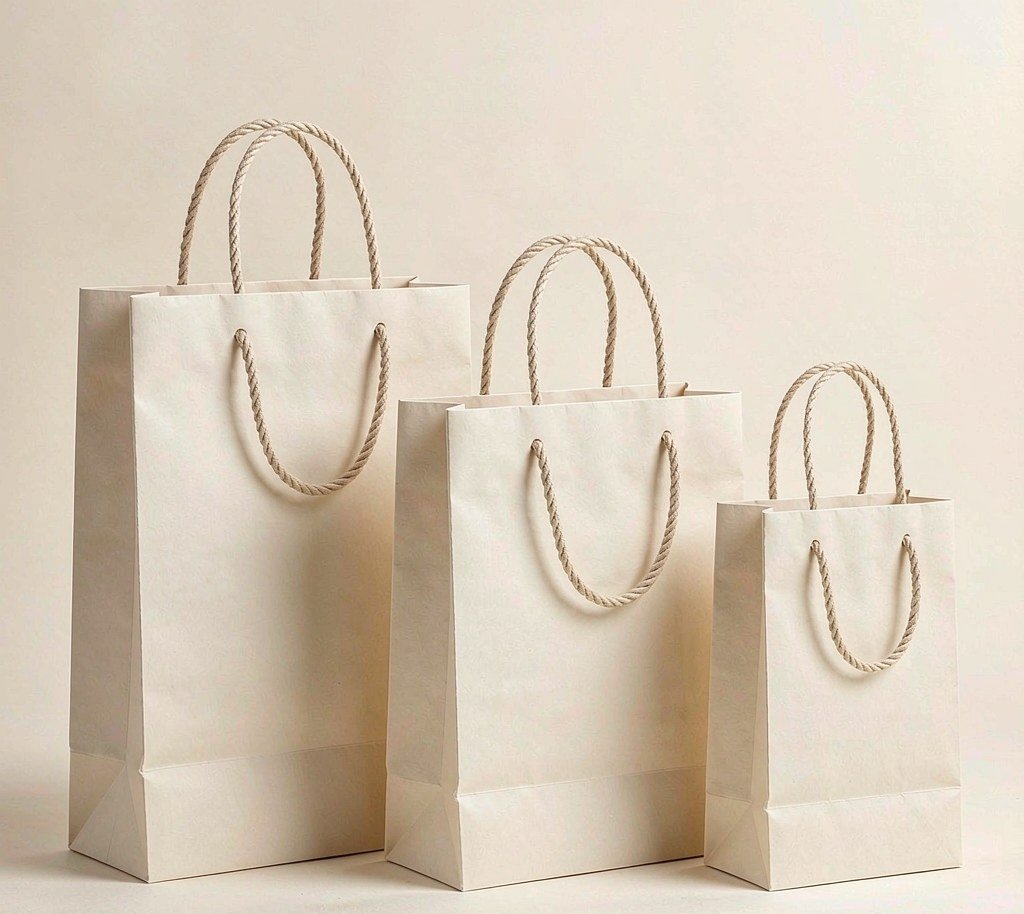
The paper shopping bag is the most under-specified item in most packaging programmes. It is bought last, briefed fastest, and judged instantly — a customer carries it through a shopping centre, sets it on a table, and in a growing number of cases photographs it. A bag that creases at the top edge, whose handles pull out under load, or whose surface feels like a laminated brochure undoes an expensive box programme in ten seconds.
This guide explains how luxury paper gift bags are built, what each specification decision costs, and where the real quality risks sit before a container leaves the factory.
Anatomy of a Paper Bag
Every paper bag, from a bakery takeaway to a flagship store, is built from the same five parts:
- Body stock — the paper or board that forms the face, gusset and back.
- Handle — rope, ribbon, die-cut or flat paper, attached through reinforced patches or eyelets.
- Top reinforcement — a folded or doubled top edge that prevents the bag opening from curling.
- Base board — a rigid insert that lets the bag stand and carry weight.
- Surface treatment — lamination, varnish or none, which decides both appearance and recyclability.
Most quality complaints trace back to one of the middle three, which are exactly the parts a buyer cannot see in a photograph.
Paper Stock: GSM Is Only Half the Story
Grammage tells you weight per square metre. It does not tell you stiffness, bulk, or how the sheet responds to folding — the properties that decide whether a bag stands upright or slumps.
- White card (coated one side or both) — 210–350 gsm. The standard choice for printed retail bags. Crisp, bright, prints sharply.
- Kraft paper — 120–200 gsm, natural or bleached. Lower cost, strong, and the default for a sustainable positioning.
- Art paper with lamination — the route to a matte, soft-touch or high-gloss finish. Heavier and less recyclable when film-laminated.
- Specialty textured and felt-marked stocks — cotton-feel, linen-embossed or uncoated boards that make the bag itself feel like a product.
- Recycled and FSC-certified papers — now expected by many European retail buyers, and worth documenting with a chain-of-custody certificate rather than asserting in copy.
For a bag carrying more than about 3 kg, step up to 250 gsm or above, or add a doubled top edge. Thin stock with heavy contents is the most common cause of a bag that looks premium in a sample and tired after one use.
Handles: The Part That Fails First
Handles are the highest-stress component and the most frequent cause of returns. Four mainstream options:
Twisted paper handle (paper rope)
Recyclable, plastic-free, and the natural partner for kraft and uncoated stocks. It is comfortable enough for moderate loads and photographs well against natural paper tones.
Cotton and woven rope handle
The premium standard for fashion, jewellery and cosmetics. Soft in the hand, strong, and available in dyed colours to match a brand palette. Fixing is the critical detail: a rope handle must sit on a reinforced patch or an eyelet, not simply punched through the paper.
Ribbon and satin handle
High impact for gifting and lingerie. Load capacity is lower, so pair it with lighter contents or a reinforced top.
Die-cut handle
A handle cut from the bag itself. Cheapest, fully recyclable, and appropriate for lightweight retail. It offers no comfort and little lift height, which is why it rarely appears on luxury programmes.
Whatever the handle, insist on a pull test. A simple loaded hang test at the factory catches most of the failures that would otherwise appear in a customer’s hands.
Reinforcement Details Buyers Should Specify Explicitly
Three lines in a specification do most of the work:
- Folded top edge, 30–40 mm. Stops the mouth of the bag curling and gives the handles a double thickness to grip.
- Cardboard base insert. Rigid greyboard or corrugated board at the bottom distributes load across the whole base rather than the fold lines.
- Handle patches or eyelets. Metal eyelets for a jewellery or cosmetics look; paper or board patches for a sustainable story.
These three details typically add a modest amount per unit and remove the majority of durability risk. Cutting them is the classic false economy.
Printing and Surface Finish
Offset printing gives the best colour fidelity and fine detail on coated stocks. Flexographic printing is economical for larger runs on kraft and uncoated papers, though it holds less detail. Screen printing is still used for heavy opaque whites and metallic inks on textured stock.
On finishing, the choices have real consequences:
| Finish | Look and feel | Recyclability note |
|---|---|---|
| Matte lamination | Soft, modern, fingerprint-resistant | Film layer complicates kerbside recycling |
| Gloss lamination | High shine, strong colour pop | Same as above |
| Soft-touch lamination | Velvet hand-feel, premium | Same as above |
| Water-based matte varnish | Slightly drier matte, good protection | Generally repulpable |
| Spot UV | Gloss pattern over matte | Depends on base finish |
| Hot foil stamping | Genuine metallic mark | Foil areas are not repulpable |
If the bag needs to carry a recyclability claim in Europe, the safest construction is uncoated or water-varnish-finished stock, paper handles and paper reinforcement — a fully repulpable bag with no film layer.
Standard Sizes and Why You Should Not Use Them Blindly
Most factories hold tooling for common sizes: small gift, medium boutique, large apparel, and various bottle formats. Using a standard size removes die cost and shortens lead time considerably. But the bag must be proportionate to its contents. A box that occupies two-thirds of the bag’s width looks considered; a box that fills it exactly looks cramped, and one that swims in a larger bag looks careless.
A useful starting point is to size the bag to the packed box plus roughly 20–30 mm on width and depth, and with enough height for the product to sit comfortably below the handle line.
What Drives the Price
- Quantity — printing plates, dies and setup are amortised across the run.
- Paper grade and grammage — the largest single variable after quantity.
- Custom size versus standard tooling — a new die plus additional lead time.
- Number of print colours and finish passes — each pass is a separate production step.
- Handle type and fixing method — cotton rope and eyelets cost meaningfully more than die-cut.
- Hand assembly — reinforced tops, patches and glued bases are labour, and labour is a real cost line.
Because bags are bulky and light, freight is also a structural problem: they occupy volume without weight, so a container fills before it reaches its weight limit. Ask for bags nested and bundled tightly, and compare landed cost per bag rather than unit price.
Quality Control Before Shipment
- Loaded hang test on both handles, above the intended working load.
- Top edge checked for curling and for even fold width.
- Base insert checked for fit — it must not shift when the bag is loaded.
- Colour against a signed reference under standard lighting.
- Surface damage check, since bags rub against each other in cartons and scuffing is a common complaint.
- Count and carton labelling verified against the packing list.
Bottle and Wine Formats: A Special Case
Bags for bottles are the most demanding common format, because the load is concentrated, the bag is tall, and the customer expects to carry it by one handle without the base sagging. Three specifications make the difference. First, a base insert of rigid greyboard rather than thin board — a bottle concentrates its weight on a very small footprint. Second, a doubled top edge and a handle attached through patches or eyelets rather than punched directly, because the entire load passes through those two points. Third, a wider gusset so the bottle stands upright without leaning against the printed face.
If the bag will be used in retail for bottles, test it with a full bottle rather than an empty one. The difference in perceived quality between a bag that carries confidently and one that flexes visibly is enormous, and it is the kind of detail a customer remembers long after they have forgotten the print design.
Frequently Asked Questions
What GSM should a luxury gift bag be?
For most premium retail applications, 210–250 gsm coated card or 200 gsm and above for kraft. If the bag carries heavier items, increase the grammage or add a doubled top edge and a reinforced base rather than relying on weight alone.
Can I match gift bags to my gift boxes exactly?
Yes, and it is worth doing. Specify the same wrapping paper and the same finish family so the box and the bag read as one object. Where you must economise, keep the paper texture consistent and simplify the print, not the substrate.
Are paper bags actually more sustainable than plastic?
It depends on material, reuse and end-of-life. A repulpable, uncoated, FSC-certified paper bag that is reused several times performs well; a film-laminated bag with foil detailing and a mixed-fibre handle is harder to recycle. Choose the construction before you choose the claim.
If you are refreshing a retail bag programme, send us your box dimensions, contents weight and preferred handle type. We will propose a stock and structure that holds up in use, matches your boxes, and can be documented if you intend to make a recycling claim. Our gift packaging line covers bags, boxes and sets as a single programme, and you can request a quote with your sizes and quantities.