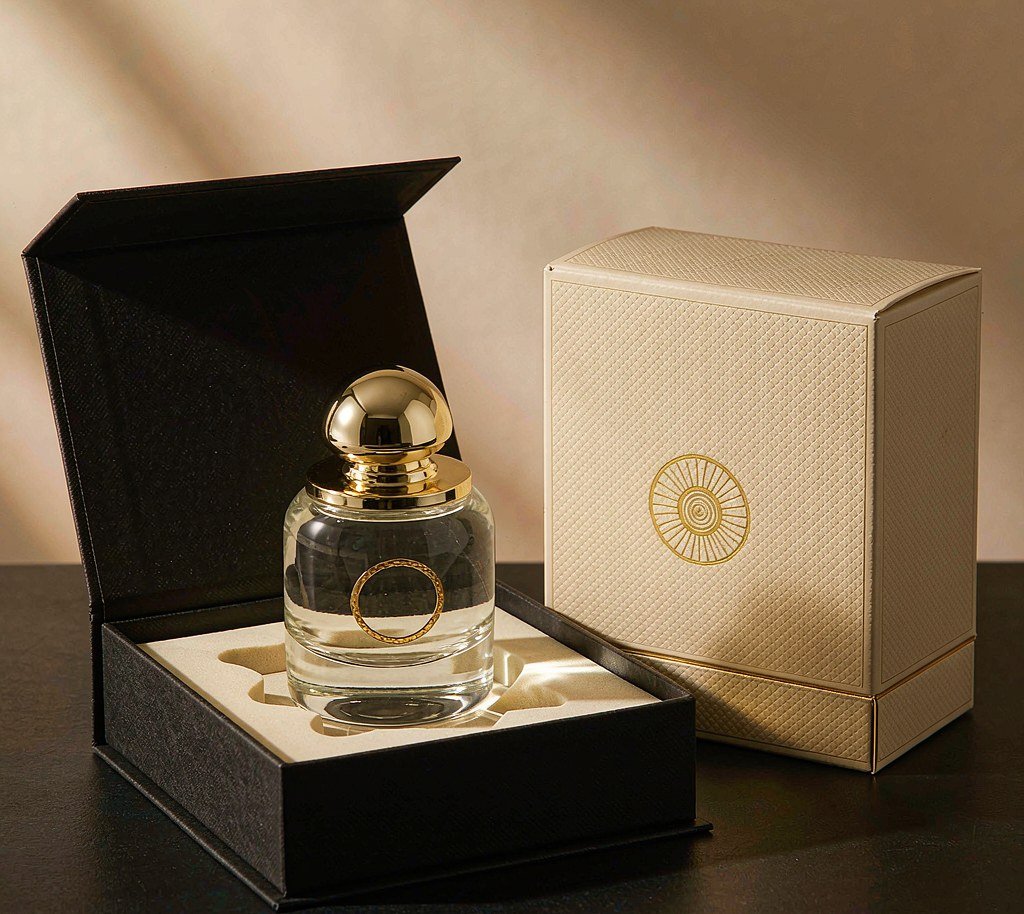
Fragrance is one of the few categories where the packaging is not a cost to be minimised but a sales argument to be won. A consumer cannot smell a bottle through a screen, and in physical retail they rarely open the cellophane before buying. What they judge first is the box: its weight in the hand, the crispness of the fold, the way the lid resists for half a second before releasing. That half second is engineering, not decoration.
This guide walks through the structures, materials, finishes and cost drivers that decide whether a perfume box protects margin or destroys it, and what has changed in 2026 for brands selling into Europe, North America and the Gulf.
Start With the Retail Price, Not the Box
The single most common briefing mistake is choosing a structure before agreeing a cost ceiling. Packaging is a percentage of landed cost, and that percentage should scale with retail price. As a working rule used across the industry, primary packaging sits somewhere between roughly 5% and 15% of the targeted landed cost budget. A mass-market body spray and a niche extrait cannot share the same specification, even if the bottle diameters are similar.
Write the target down before you open a supplier conversation. “We need a premium unboxing moment at under USD 1.10 per unit at 5,000 pieces” produces a very different, and far more useful, quotation than “we want it to feel expensive.”
The Five Structures That Cover Most Fragrance Lines
1. Folding carton (printed paperboard)
Paperboard, usually 250–400 gsm, die-cut and creased so it ships flat and is erected on the packing line. It is the most economical option, prints exceptionally well, and supports hot foil, spot UV and embossing. Choose it for mainstream retail, high volumes, and any line where every gram of freight matters.
2. Rigid box (greyboard)
A non-collapsible box built from 1.5–3 mm greyboard and wrapped in printed or specialty paper. The board gives it mass and rigidity; the wrap gives it surface. This is the default premium structure for fragrance because it cannot deform in transit and reads as expensive before it is opened. It ships assembled, so cube utilisation is worse than a folding carton — a cost that must be priced in.
3. Magnetic closure box
A rigid box with concealed magnets in the flap. It adds a deliberate, two-handed opening motion and a tactile click. Use it for hero SKUs, limited editions, gift sets, and any launch where the unboxing will end up on video.
4. Drawer box
An outer sleeve with an inner tray that slides out, often finished with a ribbon pull. It creates a two-stage reveal and keeps the bottle hidden until the consumer commits. Well suited to discovery sets, coffrets and travel formats.
5. Book-style and shoulder-neck boxes
Book-style boxes hinge like a hardback and suit flat, wide formats such as coffrets. Shoulder-neck boxes use a close-fitting neck inside a larger shoulder to create a visible gap — a strong architectural look for minimalist brands.
Materials: Where Quality Is Actually Decided
Two boxes can look identical on a quote sheet and feel completely different in the hand. The difference is almost always the board and the wrap.
- Greyboard — recycled paperboard, 1.0–3.0 mm. Thicker board means a stiffer box, a heavier hand and a cleaner edge.
- Wrapping paper — art paper (128–157 gsm) for bright print, specialty textured papers, soft-touch matte, or uncoated stock for a dry, natural feel.
- FSC-certified board and paper — chain-of-custody certification is now a routine question from European retail buyers, not a differentiator. Ask for the certificate number and keep it on file.
- Inserts — EVA foam gives precision and a jewel-box feel; moulded pulp supports a fibre-based sustainability story; paper partitions and corrugated fitments are the economical middle ground.
If the bottle is heavy, oval, or unusually proportioned, involve the packaging engineer at the structure stage. Retrofitting an insert after the box is designed usually means a new die, a new budget and a slipped launch date.
Finishes, and What They Cost
Finishing is where luxury packaging earns its reputation — and where quotations quietly diverge. Hot foil stamping applies metallic or coloured foil under heat and pressure; it reads as genuine metal and wears well. Embossing and debossing raise or recess the paper for a tactile mark. Spot UV adds a gloss pattern against a matte surface. Soft-touch lamination delivers the velvet hand-feel that premium beauty brands favour.
Practical advice: two finishes executed well beat five finishes competing for attention. Foil on a matte, textured stock with a single embossed logo is a specification that still looks considered ten years from now.
What Actually Drives the Unit Price
| Cost driver | Effect on unit price | How to manage it |
|---|---|---|
| Quantity (MOQ) | Setup, dies and plates are amortised across the run | Consolidate SKUs; share one box across two fragrances |
| Structure | Rigid and magnetic boxes cost more than folding cartons | Reserve premium structures for hero SKUs |
| Box dimensions | Larger surface area means more board, paper and freight | Reduce dead space around the bottle by 2–3 mm |
| Number of finishes | Each pass adds a separate production step | Limit to two; combine where possible |
| Specialty paper | Textured and imported stocks carry a premium | Test a mid-range stock before upgrading |
| Freight density | Assembled rigid boxes cube out containers early | Compare assembled versus flat-packed landed cost |
Note the last row. A cheaper box that ships badly can cost more landed than a more expensive box that nests efficiently. Always compare quotations at landed cost per unit, not ex-works price per box.
Compliance Points European and Gulf Buyers Now Ask About
Packaging regulation has moved from a footnote to a purchasing criterion. In the European Union, the packaging and packaging waste framework has pushed brands toward recyclable mono-material construction, reduced empty space, and verifiable recycled content. General product safety rules mean the responsible economic operator in the EU must be identifiable on the product or its packaging, which affects how you place your address block and importer details.
In the Gulf, high humidity and long sea freight mean board selection and lamination matter more than in a domestic European supply chain: uncoated boxes can cockle if they are not wrapped correctly, and cheap adhesive fails in heat. Specify the environment, not just the artwork.
A Practical Quality-Control Checklist
- Colour against a signed reference sample under D50 or D65 light, never under warehouse lighting.
- Board thickness measured at four points on each panel.
- Foil adhesion tested with a standard tape pull, not by eye.
- Hinge and magnetic closure cycled at least 20 times to check magnet retention.
- Drop test the packed box — the bottle must not move inside the insert.
- Check that the box closes with a light press but does not fall open when inverted.
How to Brief a Supplier So the First Quote Is Useful
Send six things: bottle dimensions including the cap, target retail price, annual and first-order quantity, desired structure, finish preferences, and the market you are selling into. Add a reference image if you have one. A supplier who receives those six points can quote in a day and propose alternatives you had not considered. A supplier who receives “we want something premium” will quote a guess.
Frequently Asked Questions
What is the minimum order quantity for custom perfume boxes?
It depends on the structure. Folding cartons can be economical at a few thousand pieces because tooling is limited to a die. Rigid and magnetic boxes carry more setup, so suppliers tend to prefer higher volumes — though some factories, including ours, run lower MOQs specifically for startups and first launches.
How long does production take?
Allow time for sampling and approval, then production and freight. The approval stage is where schedules are lost, so budget realistic time for artwork checks and a physical pre-production sample.
Can I get a durable box without plastic?
Yes. A well-specified rigid box with a moulded pulp or paper-board insert protects a glass bottle without any plastic, and reads as more considered than a foam fitment to a growing share of consumers.
Should I print the box in one language or several?
If you ship to several markets, print the compulsory information in the language of each market and keep marketing copy language-neutral. Overprinting a single box for every market never survives contact with a distributor.
If you are specifying a fragrance box for a launch this year, send us your bottle dimensions and target cost. We will come back with two or three structures, realistic lead times and a landed-cost comparison rather than a single number. Our perfume box range covers folding cartons through magnetic and drawer boxes, and we are happy to advise before you commit to a die. You can also see how we approach board and finish selection on our materials and finishes page, or request a quote directly.